
Meta vs YouTube in 2026: Where Does Your Content Actually Get Seen?

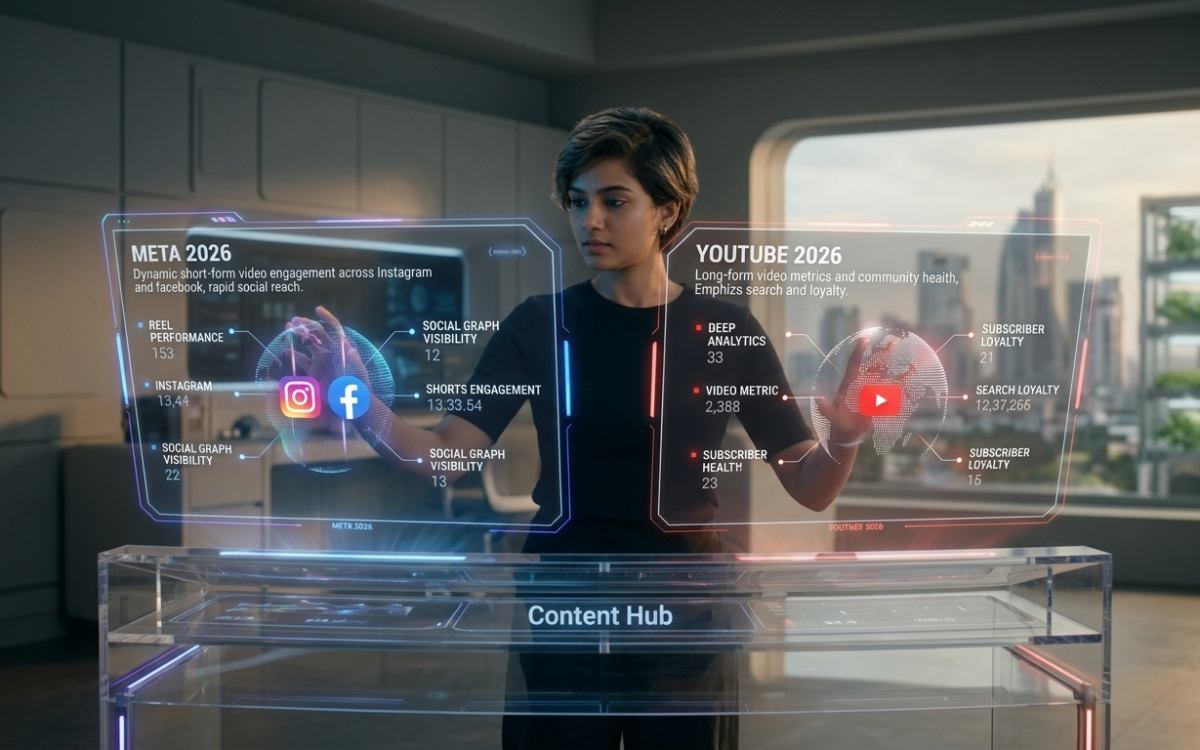
The debate over whether to use Meta or YouTube for content dissemination is arguably one of the biggest discussions within the digital marketing industry today. The answer to this debate? Well, the truth is that both platforms do provide scale, but they do so in very different ways. Here’s everything you need to know to make an informed decision.
The Scale of Both Platforms
YouTube has about 2.85 billion users in 2026, making it the second-largest platform in the world, with 491 million users in India and 253 million users in the US. Users globally spend about 27 hours per month on the platform, making it the second-largest platform in terms of time spent.
On the other side of the equation, Facebook boasts 3.05 billion MAU, which when added to Instagram’s 2.35 billion, provides an audience that simply cannot be beat, as well as behavioral signals that provide precision that competitors struggle to match.
How Meta Measures Reach in 2026
Meta is making changes to reporting in Meta Business Suite by removing Reach, Impressions, and Engagement. These metrics will now be replaced by Viewers, Views, and Interactions. This will provide a more consistent way to track performance across posts, Reels, Stories, and videos.
Optimizations in Meta’s algorithms in Q4 2025 have seen a 7% increase in views for organic feed and video posts on Facebook. 15% of total content in Facebook feed is now recommended by AI, with a strong preference for video content. Over 25% more Reels from that day are being surfaced by Facebook’s algorithm compared to the prior quarter.
Instagram vs YouTube: The Organic Reach Reality

Instagram’s organic reach per post has declined to approximately 7.6% of followers, marking a decline of 12% over the past year. It’s focusing more on paid content and heavily promoting Reels and Stories to ensure user engagement.
The reach of YouTube is different, as it relies less on the number of subscribers and more on algorithms and search engine optimization. Optimized content can reach a huge number of viewers irrespective of the number of subscribers, but the person needs to know about SEO and thumbnail optimization. The evergreen content approach of YouTube ensures that videos become popular even after months of their upload.
Short-Form: Instagram Reels vs YouTube Shorts
Instagram Reels have a much higher average number of views per post compared to YouTube Shorts for all levels of followers. For the first category of 0-500 followers, Instagram Reels have an average of 558 views, while YouTube Shorts have an average of 70 views. However, YouTube offers much more engagement and monetization opportunities.
The Engagement Quality Difference
98% of users tend to trust reviews and recommendations made by YouTubers more than what they read elsewhere. ExtraDigital This trust factor can act as a major advantage for brands that use YouTube to post educational or demonstration-based content where buying decisions need to be made.
Which Platform Should You Choose?
The answer is both – but for different reasons. Leverage Instagram Reels and Facebook for scale, reach, and top-of-funnel marketing. Leverage YouTube for search-driven, evergreen, trust, and conversion content that converts high-intent audiences. The split that has been widely recommended is 70% organic brand building and community content, and 30% paid for targeted marketing.